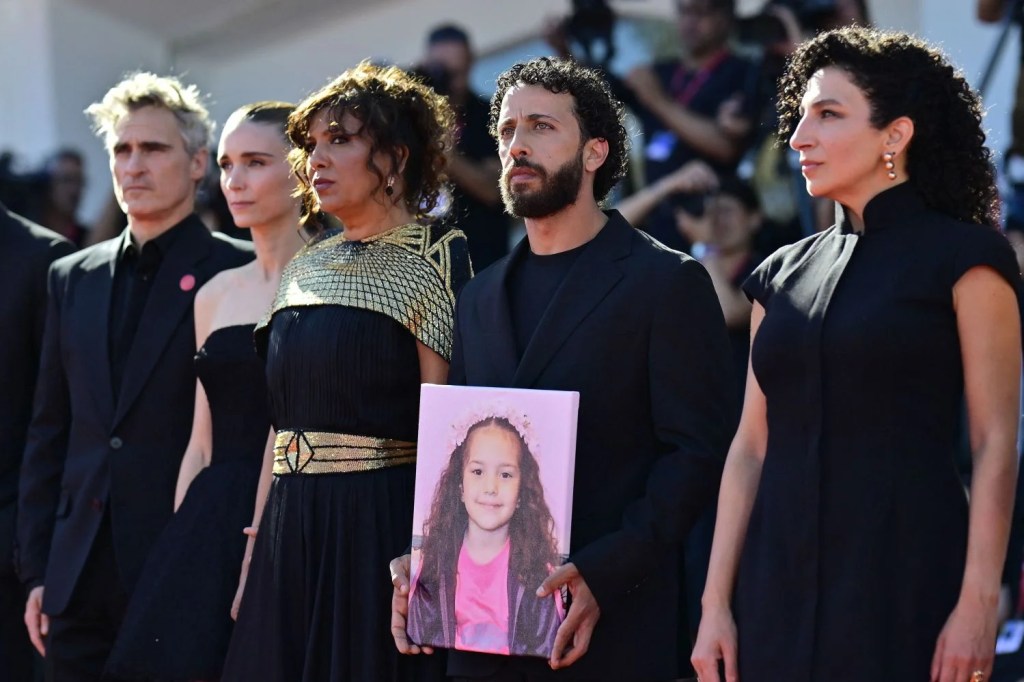
Released on June 19, 2026, in India, in The Voice of Hind Rajab every third dialogue ended with the word Habeebthi – it means darling. And no, it is not a love story – it captures the goings on in a Palestine Red Crescent Society emergency centre in Palestine which coordinates rescue operations in conflict-ridden Palestine. In just 89 minutes and a cast of five people managing the centre and Hind Rajab who only appears as a voice on a telephone, the docudrama completely shakes up its audience. It brings alive the questions of morality, our responsibility to care for children, and the role of first responders in a war situation.
The incident occurred on January 29, 2024. Omar and Rana (Played by Motas Malhees and Saja Kilani), the communicators, have received information that members of Hamada family, including five-year-old Hind Rajab are trapped in a car near a gas station in Northern Gaza. They get in touch with her on the phone line and gradually persuade her to tell them what has been happening so that they may rescue her. The conversation is what makes up the film.
It is revealed that Hind Rajab is trapped in an ambushed car with all her relatives around her dead. Rana whom Hind Rajab identifies with her own mother, manages to strike a chord with Hind and after a few hours of struggle, ensure that the ambulance makes its way to the point of rescue. Just when the ambulance reaches her, an Israeli tank shoots down the ambulance.
It is the last ambulance standing in Northern Gaza, and the two humanitarian workers die with its destruction. With that, the red crescent team members, Omar and Rana, lose contact with the girl. But not before they ask her whether she has seen the ambulance. To several questions, she answers in the affirmative.
The film used real voice recordings of Hind Rajab. It centred the voice of the girl as audio wave form. The dramatisation of the real incident by the filmmaker is an artistic masterpiece. It transports the audience to the day the event unfolded.
With just five members of the Red Crescent team and a brief appearance of Hind’s mother and brother, the cast is tight and focussed. The sound of bullets heard from a distance through the phone conversation is shocking enough to feel the situation on the ground.
Several questions come to mind as the film ends. Above all is the query – Did the Israeli Tank know that Hind was alive? There are clear indications in the film that they did. Mahdi (Played by Amer Hlehel) says the infrared sensors would tell the Army that the girl was alive. If so, Was Hind Rajab used as a bait to capture and destroy that last ambulance? The film documents humanitarian aid workers killed by the Israeli Army prior to this incident as well. Mahdi uses his influential connections to speak to the Ambassador to move the ambulance to save the child.
The efforts of the communicators including Nisreen (Played by Clara Khoury) to engage with Hind Rajab by storytelling, reciting prayers, and giving confidence is a master class in communication.
In 1945, August 6 and August 9, the United States stunned the world with the first and so far only use of nuclear weapons against Hiroshima and Nagasaki. White Light, Black Rain: The destruction of Hiroshima and Nagasaki, a documentary, depicts the crime powerfully and has won an Emmy Award. In April-May 2009, the world watched thousands of Tamils in Sri Lanka killed in a genocide. Callum Mcrae captured the war crimes of the Mahinda Rajapakse regime in a documentary ‘No Fire Zone: The Killing Fields of Sri Lanka.’ The film inspired several conversations on accountability for the war crimes.
The Voice of Hind Rajab documents one of the many war crimes enacted by Israel in Gaza in 2024. Even as ethnic cleansing and war crimes abound, the world moves on just as an organism with an afflicted organ winds its way around despite its impairment. When will the sound of voices demanding their justice, now buried beneath this sticky-as-molasses silence, emerge and touch the heart of this organism?
The film and the Red Crescent personnel’s efforts leave the audience with many questions on the effectiveness of global humanitarian networks and accountability for war crimes.
Hind Rajab, five years old, became the voice and witness of the live-streamed genocide of our time. Her capacity to use a smartphone to engage with the emergency centre for over seventy minutes is incredible. Her energy is the story of the people of Gaza.
The film, directed by Kaouther Ben Hania, preserves the memory of one of the humanity’s catastrophic failures to stop violence against unarmed civilians and children.


Leave a Reply